WinR Stuff

Showing posts with label GB Pool. Show all posts

Friday, October 23, 2015

A Nail-Biting New Release From GB Pool, Just in Time for Halloween!

Author GB Pool has come out with a standalone novel, Caverns, which is a perfect winter read and just in time for Halloween!  As someone who worked downtown Chicago, I could imagine this happening. Here is a brief description:


CAVERNS chronicles a nightmare that happens in Chicago in the dead of winter when huge caverns are discovered beneath several expensive condominiums built near Lake Shore Drive. The caves were carved out by enormous rats that have been feeding on the landfill for many decades, but the vermin are running out of food… below ground. The two men who find the caverns are being hunted in order to silence them because they know who own those condos and who authorized the shoddy city utilities project on which they were built. The powers-that-be want to bury their involvement as well as a handful of people who know about it before one of their costly investments falls into the lake. When it comes to a disaster, you have to wonder which is worse: man or beast.


Caverns is available in paperback on Amazon.

Wednesday, June 24, 2015

Dialogue – The Workhorse of the Story By Gayle Bartos-Pool

Dialogue – The Workhorse of the Story
By Gayle Bartos-Pool

Dialogue is the workhorse of the novel, short story, and screenplay. Even Silent Movies had dialogue. Dialogue performs several functions. It provides: Character Development; Plot Advancement, and Action or Movement.

In other words: It brings the story to life.


Dialogue Enhances (Describes) the Character – How a character speaks and acts says a lot more about him or her than just the words. Dialogue tells the place of birth, type of education, her temperament, his soul. Speech patterns denote character just as costumes do for an actor whether it’s a stammer or a dialect.

“Honey, somethin’s happened to yer livin’ room. Did ya’ll get another dawg?”


Dialogue Advances the Plot – and Provides Pacing – Good dialogue always adds something to the plot, whether it builds tension, relieves tension, imparts needed information to the other characters (and the reader), animates the story, thus moving it along; or even slows down the pace when you need a breather.

“Why’d you get out of the fund?”
“Frankly, I was scared. They played too rough.”
“They?” That got my attention. “Who’s they? Does Racine have a partner?”


Dialogue provides real time action. You are in the room with the characters as they speak. You are eavesdropping or right in the middle of the conversation. Or the character might be speaking directly to you. And dueling dialogue between opposing characters brings the reader right into the action. But note: as the argument gets more heated, the length of the sentences gets shorter.

“I never loved my wife!”
“Did you kill her?”
“No!”

Dialogue gets you Up-Close and Personal – Provides Tone and Mood while it brings the reader into the story. – How the words are delivered sets the verbal stage on which the scene is set; a whisper denotes mood just like a rant.

I lowered my voice before asking her my next question. “Do you outrank him?”
“No, I sleep with him,” Trin whispered.

 Remember: A character blurting out information that advances the plot is far more interesting than a long narrative description. But note: Dialogue is the illusion of conversation.

In order to know how a character speaks or acts, or even the words he uses, you must get to know your characters…intimately.
First, make the characters seem real to you as well as to your readers. Let them speak to you and trust them. Most writers will tell you they actually “hear” their characters, and it is that particular “voice” that makes a character unique.

Archie Wright’s the name. Dishing dirt’s the game. My sandbox: Hollywood. The most glamorous and glitzy, vicious, and venomous playground in the world. If you come for a visit, bring your sunscreen and your shark repellant.

Make a character sound different from the other characters with him by adding: a dialect or a foreign accent or words to denote an education or lack thereof. Add rhythm to their speech to show how the person is thinking at the time: hesitation vs. rapid-fire.  Word choice might show a character’s education level, but keep it consistent; a drugged out biker probably won’t quote Shakespeare, but a  professor in prison might quote Hamlet.

Speech should:  Move the plot along by telling us something about the character; convey information about the plot; add to the mood; change the POV to get another character’s side; and add to the reality of the piece. Just make sure somebody (a character or the reader) learns something new during any conversation. But if something is conspicuously held back, make sure it is found in the next chapter or at least by the end of the story.
If there is no purpose to the dialogue, rewrite it or dump it.

“Larry and I didn’t have children. We had two ‘vipers’ instead, just to be different. And to tell you the truth, if they didn’t kill their father, they hired someone to do it. But their funds are limited now. They’ll have to do the deed themselves.”

Language & Body Language
Simple gestures describe the characters more fully than words alone. Instead of: “Go ahead. Date my ex-wife!” he shouted. Try: “Go ahead. Date my ex-wife,” he said while slamming his fist into the wall.

Body language or Stage Business Helps Dialogue.

            “I love you,” he said.
She blew smoke in his face. “How nice.”

Instead of a constant stream of he said/she said, use stage directions to show how someone is reacting while talking.

“I’m crazy about you, too,” she said, looking at her watch.

Internal monologue can shake things up.

I couldn’t believe they found Brad’s body. I thought I buried him deeper.

Things to Avoid:
Expository dialogue: “As you know, Fred…”
Pleasantries: “Hello. Nice weather we’re having.”
Long speeches - Unless you’re Shakespeare; less is always more in dialogue.
Adverbial action tags like: “I loathe you,” she said fiercely. – can be replaced with action: “I loathe you,” she said, grinding her cigarette into the back of his hand. “Have a nice day.   Instead of: he said gravely. Try: with his head bowed he said...  
Sometimes what the character doesn’t say is important: “I knew you wouldn’t care if I left you,” he said. She bit her lip.
Keep you, the writer, out of the piece. Don’t let your thoughts get tangled with those of your characters.

Write a biography of your main characters, whether it’s a paragraph or a page, describe who they are, where they came from, their background. Where a character was “born,” went to school, and his neighborhood will dictate his speech pattern, whether it’s a Southern drawl, a French accent, or a gangsta rapper from the ‘hood.’
If you are having difficulty, start with a “stock character” straight from central casting. If you want a villain, pick a character from some old movie, like Edward G. Robinson, and than mold him into your own creation. You can always find a picture in a magazine that fits the type of person you want in a particular role. Cut the picture out and devise a background for him or her.
If you know your characters, you can find their individual voice, even if the character isn’t human. Dogs, cats and birds have found their way into great stories.

After you have written your scene, read it aloud or have someone else read it to you, or use one of the many software programs that reads your work back to you. It will make a huge difference. You will hear things you didn’t know you wrote (both good and bad) and you will pick up the redundancies and misused words. And you just might find out how good you are at writing dialogue.


Let your dialogue work for you. It has a lot to say.   

Wednesday, February 25, 2015

Character Matters: Your Main Characters Attract Readers, Make Them Memorable


Author G.B. Pool gives us the scoop on writing memorable characters. Visit Gayle's Author Page on Amazon!

Character Matters: Your Main Characters Attract Readers, Make Them Memorable


Aristotle wrote in The Poetics that stories are made up of 5 Elements in balance: Plot, Character, Setting, Dialogue, and the Meaning of the Piece. He thought plot was the most important element, but I wanted to talk about character in this blog.

As in most crime fiction, there is always a bad guy or gal. Some writers want to give the villain a good point like he loves dogs or his mother. I seldom bother. I paint him bad with no redeeming features unless there are extenuating circumstances and my bad guy isn’t so bad after all. In fact once or twice the bad guy has a soul. But usually in a story like that, he or she is actually the star of the piece.

But when I write a main character, I want him or her to be someone I would invite into my home. After all, I spend a lot of time with these characters while I am reading not only my own books but books by other writers. If I find them repulsive, mean, heartless, I really resent the time spent getting to know them. On more than one occasion the character has been written by a famous author and I frankly think the character stinks. That will also be the last time I read one of their books.

Aristotle mentioned that characters should have some redeeming quality. I do reserve those good qualities for the hero and other important characters. The bad guy can be bad to the bone as far as I am concerned.

Another thing Aristotle mentioned was that all the characters should be appropriate to their station in life. I am sure when he wrote The Poetics there was far more of a class system operating. Even in Downton Abbey, the folks living above stairs have a different attitude than the ones living below stairs. Not that this is right or wrong, it was just what society at that time and place was like. I’ll root for the rebel, but I would still be cognizant of the time period in which the story was being told.

There was a movie, The Admirable Crichton, where a shipwreck strands a bunch of aristocrats and their butler on a desert island. The resourceful butler saves everyone with his ingenuity. When the bunch is rescued, he reverts back to the butler and life went on.

But if the writer is true to the inherent abilities of his characters, the story will work. A housewife who miraculously knows everything about solving crime has been watching too much CSI. And a cop will tell you many of the procedures on those police shows are laughingly wrong.

Dick Francis will have his main character who is expert in some interesting thing like wine making or photography, use his skills to solve a crime. That I can believe. If he turns into a latter-day MacGyver and can make a nuclear weapon out of a box of matches and a can of hairspray, sorry, NO SALE.

Just keep your character consistent. If he hates height, make something payoff in the end that uses that fear of heights like Jimmy Stewart’s character in Vertigo. I keep a character chart that lists when each was born, when certain things happened in his life, and even things that happened during that time in history just to know what people were exposed to.

  I started doing this while I was taking an acting class. What a great way to learn about a tight story structure, dialogue, and character. My teacher, Rudy Solari, had us write a mini-biography of our own character so we would know where the character came from and what motivated him or her before he or she set foot on the stage. We could glean some things from the script and make up the rest, but you sure know who you were when the scene started.

This works for writing characters, too. When I was writing my Johnny Casino Casebook series I wrote out a bio for Johnny. Boy did I learn a lot about him. There were even some things that came out in the second book that even Johnny didn’t know. It made him more interesting.

Know your character. Character matters.

Thursday, May 20, 2010

Hobbies, Passions, and Writing

by G.B. Pool

Writing may be your obsession, but you might also have a hobby or passion that sometimes helps you over those dry times when a story isn’t quite gelling and you need to leave the keyboard.


Some “crafty” writers use their hobbies, like quilting, cooking, or bookbinding, as a launching pad for their writing. I set up a mystery panel once called “Murder on the Menu” which featured authors who write stories around cooking. Joan Del Monte (Death Has a Yellow Thumb) mentioned that for some reason, mystery writers eat a lot in their books, so writing about food is a natural. Check it out.


Dick Francis gave his heroes a hobby or profession that always played a part in the story. And frankly, it’s fun for readers to learn something new about a topic they know little about. It’s the cherry on top of the sundae.


So if you have a hobby or an interesting job, why not incorporate it into your story? You are probably an expert on the subject, and you sure know the terminology, so why not share that knowledge with the reader?

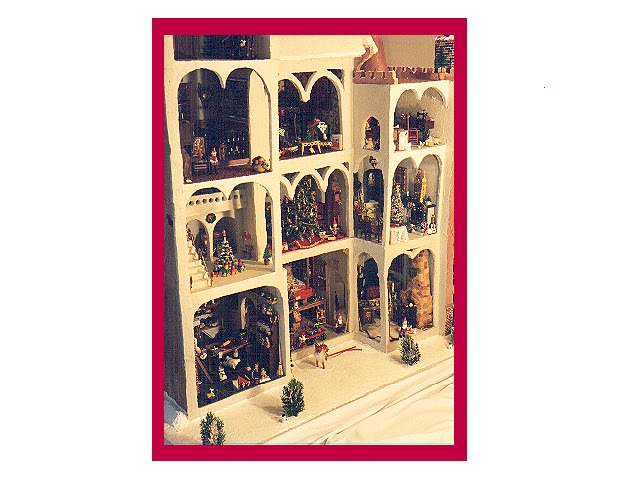
Years ago I worked for a miniature shop. We sold dollhouses, tiny furniture, and precious little knick-knacks. I made many of the things for the store. We also had a Christmas shop in the back with hundreds of ornaments, Santas, and holiday decorations. I became obsessed. I have over 3500 Santas.


As a writer, I thought of a story that would include a Santa Castle, a talking Polar bear, and of course, Santa Claus. I designed a castle on paper and eventually wrote the story. Years later, I built the castle, furnished the rooms and crafted the Polar bear and even Santa. The story hasn’t been published as yet, but the creative work is done.

I was on a jury many years ago. It wasn’t a terribly exciting case, but my imagination came up with a much better story about a former private detective who ended up on a killer jury. I used to be a P.I. myself, so it wasn’t much of a stretch to write about my heroine’s background. The book is published, Media Justice. You can even get it on Kindle.

Your hobbies and life experiences can find great places to grow in your books. At least they are a starting point for ideas. After going with my husband to the horseraces at Santa Anita Racetrack, I wrote my second Gin Caulfield novel. And remember, if you have a hobby, an interesting job, or have been to a cool place, you have firsthand knowledge. That ring of truth will add to the reality of your story and you have already done the research.

Friday, April 9, 2010

Edits, Rewrites, And Selling Your Soul

Author G.B. Pool has plenty of experience editing her work, and with one novel and a list of anthologies under her belt, her methods must work!


Every “How to Write” book has a chapter on “Editing and Rewriting.” Whatever you write can always be improved by a careful edit, and thoughtful look-over, and a final rewrite to tweak those areas that don’t sound right. You could spend the rest of your life rewriting if you aren’t careful. Hopefully you have a friend who tells you to stop before you rewrite the life out of your work.

Over-writing is a problem we can all have when we are looking for the perfect word or phrase. Maybe you should try looking for the best word, and not worry about perfection. Perfection is stuffy. Walk away from your work, literally, go into another room, and think about what you want to say in that section. The words that come into your head, off the cuff, will be truer than the ones you agonized over. Spontaneity is always fresher. Write it down and then leave it alone.

As for basic editing like grammar, spelling, and punctuation, have someone else do it for you. Just like parents who never see flaws in their children, even the two-headed ones or the ones who wind up in jail, you will miss errors in your own work.

Join a writers’ group, ask a teacher, or pay a professional to go over your work. Even if your Aunt Mabel is a professional editor, too often a friend or relative will be too kind. (They will overlook the two-headed kid, too.) An agent or publisher won’t be kind. They will toss your error-laden manuscript in the trash and remember you the next time as the person who can’t submit a professional piece of work.

Make sure that writers’ group you join isn’t afraid to point out mistakes, holes, or continuity problems. A good teacher will know how to get out the red pencil and correct grammatical errors. And a professional editor has seen it all before and will know how to spot obvious errors. It’s worth the money.

So you rewrite, edit, polish and submit. And an agent likes your work. Hoorah! Your characters are memorable. The plot is appealing. The agent handles that genre. They know a few publishers in that genre. Everything is wonderful…but…

It’s the “but” that will have you asking yourself, “How much of my story will I change to get it published?” If the change doesn’t amount to much, I’d rewrite it in a heartbeat.

But what if your agent loves everything except one of the key points in the story around which everything revolves. Should you tell her she should really read the entire book to see how it fits together, or do you try to adjust the part she doesn’t like to suit her?

A screenwriter will tell you once you submit your script, a thousand hands will rework it, reshape it, and in the end you won’t recognize anything but the title…if they keep the title. Screenplays aren’t novels.

How much of your book are you willing to change for someone else? Granted the agent has the contacts, the clout, the name recognition that could get you published. But what will you be giving up? Your name goes on the cover. You are the one who will be explaining why the plot missed the mark…for eternity. You have to make that decision.

My advice: First, find a way to explain to the agent/publisher exactly why you can’t change that major plot point. Thank them for pointing out the fact you didn’t write that part clear enough and say that you will tweak that section. If that doesn’t work, ask yourself: What do I value most?

And remember: Your agent might be wrong.

Friday, January 22, 2010

Publicity Responsibilities versus Author Payment

An interesting article appeared in the January 2010 issue of The Writer. Author M.J. Rose suggested that book authors should be compensated for publicity duties. Since the marketing effort is no longer born by the publisher, revenues should be more equitably split.

Read what the WinRs have to say and then let us know what you think!

****

Jacqueline Vick self-published her children's book, Logical Larry. She has several mystery manuscripts making the rounds.

I hadn't really considered this issue before, assuming that advances were destined to be spent on marketing, but Ms. Rose's comments made me wonder if I'd been going with an outdated assumption.

Her two suggestions in the article were to allow authors to subtract marketing expenses from their book advance so they could collect royalties sooner and to give athors a highter royalty rate.

I'm a big fan of "buy in", and if authors saw a benefit to spending those hard earned dollars on marketing (other than possible increased sales) then more authors might be effective at selling more books--a benefit to publishers.

Why not a tiered royalty system to give writers something to work for? This system has been used to incentify sales people for decades.

Would this system keep publishers from purchasing as many manuscripts? I don't see why. There would be more opportunities to earn revenue.

That being said, publishers are in control unless an author self-publishes. If the current business plan says that authors have to cover publicity costs out of their own pocket, then those serious about a writing career will do it.  I think that's what defines a successful person--she jumps in and does the stuff that most people complain about and avoid.

Another interesting note from the WD article (paraphrased): If you run into a musician and they've hired a studio and musicians and put together their own CD, you don't automatically thinks it's sub-par, that if it was good, he'd have signed with a label. Why is it that we assume self-published books are "unworthy?

Some of my favorite books and CD's have been put together by the artist. I'm smart enough to flip through a book to see if I like the writing style before I buy it, and I've bought plenty of traditionally published books that I've hated. I'd rather run into a grammar error in a fabulous story than have a perfectly edited book that's a stinker. I also don't sneer at hand-crafted goods that aren't mass produced and sold at department stores. I actually hold them in higher esteem.

***

Jackie Houchin is a photojournalist and a book and theater critic. She has written several manuscripts, so she can give us the perspective of one who isn't actively seeking publication but may do it in the future.

If I ever did anything with the kids' stories (or the women's novel) I wrote, I would DEFINITELY self publish, no if's, and's, or but's, about it. That way, I would not have to deal with sharing any of my advance with the publisher over marketing strategies and profits. (Of course, I wouldn't be getting any advance - ha-ha). Instead, I'd be able to decide just how much effort I wanted to put into the project. I definitely wouldn't be doing it "for the money".

Since being in the SinC and MWA organizations, I've heard countless authors bemoan the facts of publication:

---that it is very hard to get an agent or publisher even interested in your work...

---that it takes years to publication even after one agrees to look at your work...

---that you don't get any money to speak of...

---that you are supposed to market yourself or at least come to them with a huge "platform" so they don't have to do much but reap the benefits...

---that you may not get a contract for another book...

---that you may be dropped if you don't sell as much as they like...

---that your publisher may go out of business.

It makes me wonder why anyone would want try to break into the fiction industry right now.

All this sounds depressing, I know, but that's the reason I would go FIRST to a self publishing and/or POD method.

Of course another factor for me might also be that I've always worked for myself (in photography and reviewing) and could pretty well set my own parameters. 
As for your original questions, I don't think authors have much say in what publishers do at this point. They may feel a larger advance is warranted or that they should be able to deduct marketing expenses from their advances - but that is really up to the publishers. I do feel that marketing should be a tax-deductible item...but, isn't it already for the serious writer?

***
Bonnie Schroeder has finished her first novel manuscript and is shopping it to agents.

First off, from everything I’ve read and heard, nobody earns a living off their books – except for a lucky handful of writers. My biggest gripe is the lack of attention given to new authors, but the reading public has to share the blame. Few people seem willing to invest their time and money in an unknown author not sanctioned by Oprah. Publishers make their money off superstars like King and Evanovich, and it appears from the sidelines like these writers don’t even need much marketing beyond an announcement of their next new blockbuster. It doesn’t seem fair (the “F word” in business) that these writers get free publicity that they don’t even need.

So, if I did get past all the gatekeepers and obstacles and finally sold a book and then if had to pay for my own marketing and publicity, my first question would be, what the heck is the publisher even doing for me besides (maybe) strong-arming the local Barnes & Noble into stocking a few copies of my book? I’m still looking for an answer.

However, since I guess I understand the realities of the marketplace, and since I’ve chosen to play this little game, I’d swallow my resentment and do whatever I could afford to do, to show the world what a great book I’ve written. It would then make sense that if I do a good job and work up enough interest to generate sales, that after a certain threshold (and I have NO IDEA what that would be), I’d get reimbursed for my expenses and that the publicity for the second/ third, etc. book would be covered by the publisher.

***

GB Pool is the author of several short stories which have appeared in Anthologies and penned the novel Media Justice.

The End of the Buggy Whip

Fair? Who said life was fair? Or for that matter, the publishing business.

Publishing came to America around 1800. Many famous publishing houses started back then. By the end of the 19th Century there were hundreds of publishers and a smattering of writers. The vast majority of Americans worked on farms or in factories with no time to write. Today there are five major publishers still in existence, most owned by foreign enterprises, with a smattering of small publishers picking up the slack. Farms have mechanized, factories have moved to China, but now there are thousands and thousands of writers.

What used to be a hard back book business changed into a paperback and trade paperback enterprise. It’s cheaper to make those paperbacks. Then came discount stores and Amazon. Now there is Kindle and the other downloadable reading devices that don’t require paper at all. And don’t forget the self-published author. Even the few name publishing companies provide POD (print-on-demand) books.

As the changes in the publishing business hit, the revenues shifted. No longer are people buying those expensive hard cover books. The trade paperback sometimes comes out six months after the hard cover version. And the downloadable book will soon follow.

As the revenue shifted, so did the perks. Editors disappeared. Book tours and publishing house publicity vanished. (They got rid of the buggy whip, too. Want to go back to the horse and buggy?)

Publishers aren’t making the money they used to, even with the outrageous cost of those hard cover books. Most of the old publishing companies don’t exist. If you are lucky enough to get one to publish your book, show them you will go all out to help sell that book of yours. Your effort will not only help to sell more books, but your publisher will see you as a go-getter and they might be more eager to take on your second book.

With the tremendous number of would-be writers clamoring for their books to get noticed and eventually be published, it will be the writer with the skill and nerve to face those audiences and sell their book themselves who will succeed.

Welcome to the new normal.

Sunday, January 3, 2010

An Interview with GB Pool


A former private detective and once a reporter for a small weekly newspaper, Gayle Bartos-Pool has one published book, Media Justice, and several short stories in anthologies, including  LAndmarked for Murder and Little Sisters Volume 1. The former Speakers Bureau Director for Sisters in Crime/Los Angeles, she is also a member of Mystery Writers of America. Her latest short story appears in the anthology, Dying in a Winter Wonderland, which was voted one of the Top Ten of Softcover Books as selected by the Independent Mystery Booksellers Association (IMBA) of 2008. Welcome Gayle!

With a background as a private investigator and a journalist, crime fiction seems a natural career choice for you. Do you use the experiences and skills you learned in your previous jobs to make your writing realistic?

Both previous jobs have given me insight that I probably wouldn’t have had. As a reporter, I learned that truth matters. In writing fiction, that means make sure you have the facts right. When you guess, you have a 50/50 chance of getting it wrong. Sometimes you might not realize you are guessing, but when somebody says you goofed, you try to do better the next time. I do lots research.

As for the P.I. thing, I learned two things. One, cops will cut you some slack if you make a mistake. Just don’t make the same mistake twice. And second, I learned to blend in. An undercover agent lives his environment. That means you have to be a good actor and have a nimble imagination. In the year I worked as a private detective I never blew my cover.

You went the self-publishing route with your first novel, Media Justice. What did you learn from that experience?

Hire a professional editor to go over your work. No matter how good your Aunt Mabel is, unless she’s a professional editor, she won’t catch every mistake and she won’t know ways to make your book look like Random House published it. I hired a pro to edit and another one to lay out the format and do the cover. It looks professional.

Also, self-publish as a last resort. I wanted my book published so my mother could see something of mine in print. She helped with the cost of publishing and read the next to final draft. She passed away before the book came out, so I dedicated it to her. Bittersweet results.

But if you keep hitting that brick wall with agents and just want to see your own book in print, go ahead and do it, but know that you have to sell that book, too. And if you don’t know how to get distribution, or approach bookstores, or do a book tour, or write press releases, or get on local TV, or…. There is a great deal of work AFTER you write the book. Be prepared. Or better still, write another book and see if the agents like that one better.


Recently, you put the finishing touches on your latest Ginger Caulfield mystery and presented it to your agent. Can you tell us what the book is about?

Here’s the book jacket blurb for Hedge Bet.

Gin Caulfield figured a bullet wound in the back had ended her career as a private eye, but when she and her husband stumble across a murder at the racetrack, all bets are off.

The first victim, Deirdre Delvecchio, had a loveless marriage of convenience. In less than twenty-four hours, Dee’s philandering husband, Donald, has not only convinced Gin to help him prove his innocence, but he also drops an even larger problem in her lap.

Racine Ingram, a pricy interior designer, is the problem. She does her best work at night, alone, in multi-million dollar companies.

Another possible suspect is Phil Lester, a guy with a temper, who was seen talking with Dee right before she was killed. And Phil has a few more surprises for Gin.

Gin manages to get copies of Racine’s business files and finds bloody evidence that ties someone to the murders. Then the prime suspect is killed …and Gin has to start all over again.

Can she still hack it, or is it time to hang up her .38s for good?

Several of your short stories have been published in anthologies, the latest in Dying in a Winter Wonderland. You also teach a seminar on short story structure. Is writing a short story like writing a mini-novel? Does it take as much thought?

Writing a short story takes just as much thought. Part is to ask yourself what you should include, and part is convincing yourself that you have to leave something out. You may have fewer characters, locales, and sub-plots, but they have to be interesting, maybe even more exciting than in a novel because you have less space to describe them, so you make them memorable. You must get to the point faster and you exit a lot quicker, so every word really counts. Short story writing will certainly sharpen your skills as a writer, and you will probably use those skills in your novels to make them sharper.

Can you share one tip from your writing seminar for authors who are considering the short story form?

The perfect plot is simple, not complex. Aristotle said that in The Poetics.

But something I tell my students is to always ask yourself three things about each sentence and/or paragraph you write:

Does it advance the story?

Does it enhance the story?

Is it redundant?

 You have two protagonists--Ginger (Gin) Caulfield and Johnny Casino. How do you decide which character's project to work on? Or do you work on multiple projects at the same time?


I always have a main project in the works and several other smaller projects going at the same time. I also work on my many miniature doll house projects, or other craft projects. The art work activates another portion of my brain that needs exercise every now and then. But I will certainly work on the one my agent is most interested in, even if I think the piece is finished.

 One thing that reader's can expect from your writing is razor-sharp wit. Do you ever "soften the blow" in rewrites?

No, I do just the opposite. I punch it up even more in rewrites. My characters take over and I let they have their way with the dialogue.

Until recently, you were the Speaker's Bureau Director for Sisters in Crime/LA. You successfully built that program up over several years, putting on over seventy author panels and events. Could you share some tips with author groups looking to set up the same kind of events?

Work thy butt off. That is the only way you will get the name of your organization out in front of the public. This will also get other authors as well as yourself some valuable face time and help you all see what it takes to sell that book you just wrote, regularly published or self-published authors. Contact every library in your area and ask if they would like you to set up a panel or do a solo. Try senior centers and women’s clubs in the area. Even schools. Everybody loves to hear from real writers. Writers do what most people can’t do, so you are ahead of the game from the git-go. Make good contacts, spread your business card around, and remember to smile at everybody and talk to the audience. They are all potential customers.

 There are several Johnny Casino shorts available. Are you planning to compile them into a collection?

I have already put the first eight Johnny Casino short stories into a book called The Johnny Casino Casebook. They are in chronological order and you meet several characters a few times as different cases come up. My agent has the book in her hot little hands.

What's next for GB Pool? A Johnny Casino novel, perhaps? Or a Gin Caulfield short?

I have the third Gin Caulfield book in outline and the first four chapters completed. I am also lengthening a novella about a young woman and what might be a ghost into a novel. It’s a romantic adult fairy tale.

Thanks Gayle!

Monday, September 14, 2009

"Veil of Lies" Review by GB Pool


Noblesse Oblige

Veil of Lies is a fourteenth Century tale told with Chandleresque pacing. Author Jeri Westerson centered her intriguing tale about former knight, Crispin Guest, who earns a meager living as a tracker (think private detective with a dagger). The story is replete with damsels in distress, court intrigue, holy relics, and a man's honor.

The period detail is neither boring nor scholastic, with just enough pictures painted to set the stage for sword fights and dungeons and scurvy knaves. The dialogue is just contemporary enough to give you an occasional laugh, right before you hastily turn the page, because this is a page-turner.

Crispin Guest is hired by a merchant to follow his beautiful, young wife. The wife seems up to no good, then the husband is found murdered in a locked room in the fortress like home of the rich merchant. And the wife isn't a highborn lady. She had been in service in the home before marrying the man.

Then the mystery of the veil comes to light. It’s a holy relic that seems to cast a spell over anyone in its presence, forcing them to tell the truth. But sometimes the truth can be a problem. Secrets abound. Truths are revealed. And Crispin Guest confronts his own prejudices.

A great tale, well told. The plot could have taken place in a 1930s Noir movie or in an episode of Magnum P.I. A good story is still a good story. This one just happens to have wonderful atmosphere and situations that only a former knight could experience.

Loved every page.